
AI-Assisted Coding Interviews (2026): Patterns, Examples, and Preparation Guide
LeetCode tested memorization. 2026 tests something harder: your ability to lead AI

1. Introduction — The End of the “Pure LeetCode Era”
For more than a decade, technical interviews at major tech companies largely revolved around solving algorithmic problems—often similar to those found on platforms like LeetCode. Candidates were expected to implement data structures and algorithms from memory while explaining time and space complexity. While this approach helped evaluate problem-solving ability, it never fully reflected how software is built in real engineering environments.
Today, the development workflow has changed significantly. Engineers increasingly use AI-powered coding tools such as Cursor, GitHub Copilot, OpenAI Codex, and Claude Code to assist with writing code, generating tests, debugging errors, and exploring unfamiliar APIs. These tools act like high-speed junior collaborators—they can generate code quickly, but still require careful guidance, review, and correction.
As AI becomes part of everyday development, some companies are beginning to experiment with AI-assisted coding interviews. In these interviews, candidates may be allowed—or even expected—to use AI tools while solving problems. Instead of focusing purely on memorization or manual coding, interviewers are increasingly evaluating whether candidates can:
break down problems clearly
guide AI tools effectively
review and debug AI-generated code
ensure correctness and robustness
In other words, the question is shifting from “Can you code everything from scratch?” to “Can you engineer reliable solutions while collaborating with AI?”
This marks the gradual transition away from the pure LeetCode era toward a new interview paradigm where problem-solving, engineering judgment, and AI collaboration are all part of the evaluation.
2. Why Companies Are Introducing AI-Assisted Interviews
The rise of AI coding assistants has significantly changed how software is developed. As a result, many companies are rethinking how they evaluate engineering candidates. AI-assisted coding interviews are emerging as a response to this shift.
2.1 Engineering Workflows Have Changed
Modern developers increasingly rely on AI tools such as Cursor, GitHub Copilot, Codex, and Claude Code as part of their daily workflow. These tools help with generating boilerplate code, writing tests, debugging errors, and exploring unfamiliar frameworks. In many teams, AI has become a normal part of the development environment.
Because engineers now work alongside AI tools in real-world projects, some companies believe interviews should reflect this reality rather than prohibit it.
2.2 Measuring Real Engineering Skills
Traditional coding interviews often emphasize memorizing algorithms or recalling implementation details under time pressure. While these skills are still useful, they represent only a small part of modern software engineering.
AI-assisted interviews allow companies to evaluate broader engineering capabilities, such as:
problem decomposition
architectural thinking
code review and debugging
verifying correctness and edge cases
improving and refactoring generated code
These skills are closer to what engineers actually do on the job.
2.3 AI Tools Behave Like Junior Engineers
A useful way to think about AI coding assistants is that they function like extremely fast junior engineers. They can generate large amounts of code quickly, but they often introduce subtle bugs, inefficiencies, or incorrect assumptions.
Companies want to understand whether candidates can:
guide these tools effectively
identify mistakes in generated code
refine and improve solutions
In this sense, AI-assisted interviews are not about letting AI solve the problem—they are about evaluating whether the candidate can lead the problem-solving process while using AI responsibly.
As AI continues to reshape software development, interviews are gradually evolving to measure not just coding ability, but also how engineers collaborate with intelligent tools to build reliable systems.
3. What Exactly Is an AI-Assisted Coding Interview?
An AI-assisted coding interview is a technical interview format where candidates are allowed—or sometimes encouraged—to use AI coding tools while solving problems. Instead of prohibiting tools like AI assistants, the interview simulates a more realistic development environment where engineers collaborate with intelligent tools to write and improve code.
The goal is not to see whether the AI can solve the problem, but to evaluate how effectively the candidate uses AI as part of the problem-solving process.
3.1 Tools That May Be Allowed
Depending on the company and interview platform, candidates may be able to use tools such as:
Cursor
GitHub Copilot
OpenAI Codex
ChatGPT / Claude
Internal AI coding assistants
Typically, the interview is still conducted in a shared coding environment (IDE or browser editor), but AI assistance is permitted to help with tasks like generating code, reviewing logic, or writing tests.
3.2 What the Interview Typically Looks Like
The structure of the interview often resembles a traditional coding round, but with the added ability to use AI tools.
A typical flow might look like this:
The interviewer presents a problem or coding task.
The candidate discusses the approach and solution strategy.
The candidate uses AI tools to help generate or refine code.
The candidate reviews the generated code for correctness and edge cases.
The candidate tests and explains the final solution.
Throughout the process, the interviewer observes how the candidate interacts with the AI tool, not just the final code produced.
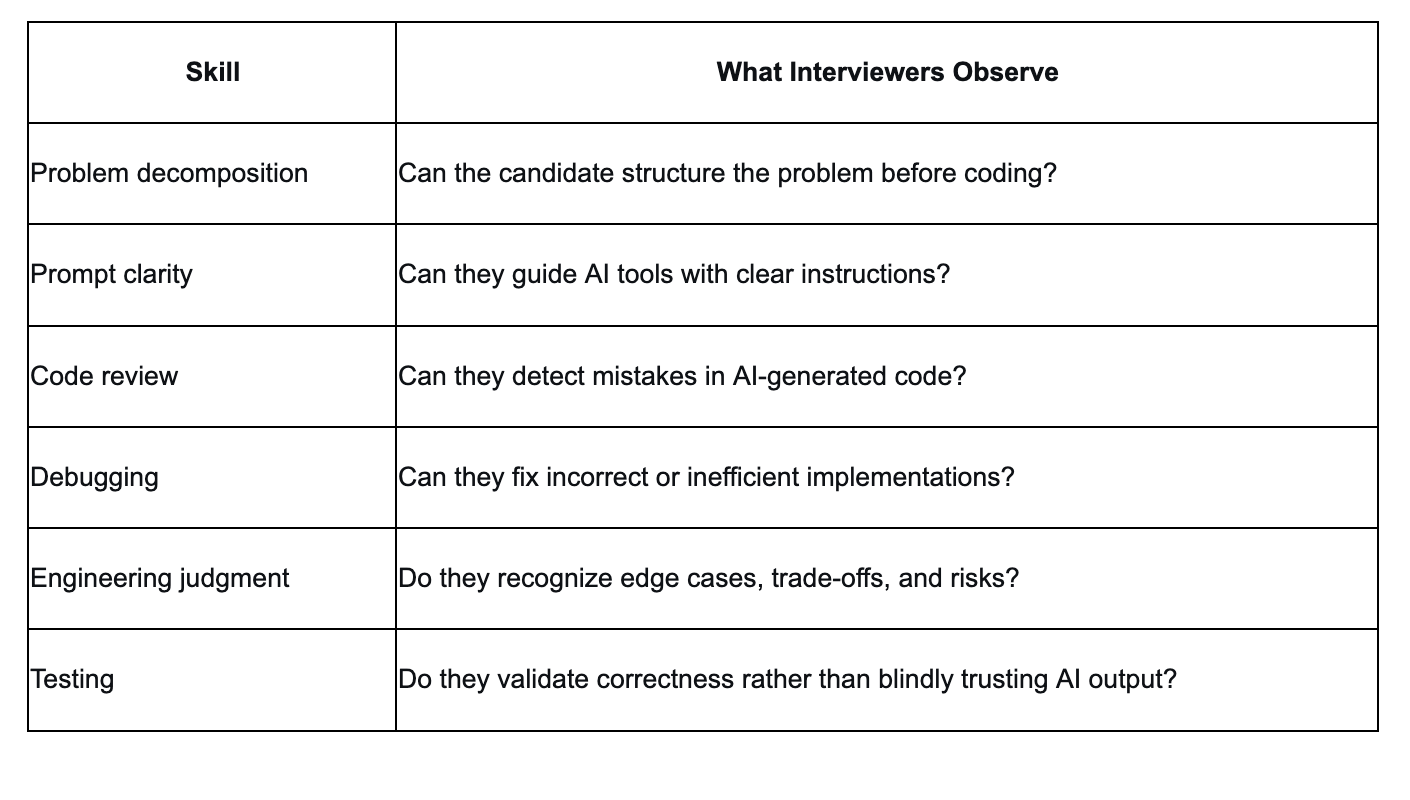
3.3 What Interviewers Are Actually Evaluating
A common misconception is that these interviews test how well someone can prompt an AI model. In reality, interviewers are evaluating broader engineering abilities.
Key signals they look for include:
4. The Five Most Common AI Coding Interview Patterns
Although AI-assisted interviews may appear very different from traditional coding rounds, most of them follow a small number of repeatable patterns. Understanding these patterns helps candidates prepare effectively, because interviewers usually design problems that fit into one of these categories.
Below are the five most common patterns currently appearing in AI-assisted coding interviews.
4.1 AI-Assisted Implementation
In this pattern, the candidate is asked to implement a feature or algorithm while using AI tools to assist with coding.
Example questions
Implement an LRU cache
Build a rate limiter
Implement a file search utility
Create a simple REST API service
The interviewer observes how the candidate:
breaks down the problem
guides the AI tool to generate useful code
reviews the generated implementation
handles edge cases and correctness
My Advice: As a candidate, start by explaining your approach before touching the AI tool. Then use AI to generate scaffolding or boilerplate code, and finally review, test, and refine the solution yourself.
4.2 Debugging AI-Generated Code
Another common format is to provide candidates with code that was generated by an AI model but contains bugs.
The candidate’s task is to identify the issues and correct them.
Example problems
Fix a binary search implementation that fails on edge cases
Debug a concurrency bug in asynchronous code
Identify incorrect logic in an algorithm implementation
This pattern evaluates skills that are increasingly important in the AI era:
reading unfamiliar code quickly
identifying logical mistakes
verifying correctness rather than trusting AI output
My Advice: As a candidate, resist the temptation to immediately ask the AI tool to fix the code. Instead, first understand the logic, identify the root cause of the bug, and then use AI selectively to help generate or verify a corrected implementation.
4.3 Extending an Existing Codebase
In this pattern, candidates are given a working codebase or service and asked to extend its functionality.
Example tasks
Add authentication to an API
Implement pagination for a data endpoint
Introduce caching to improve performance
Add logging or monitoring
The challenge here is not writing code from scratch but understanding existing code and modifying it safely.
Interviewers evaluate whether the candidate can:
read unfamiliar code quickly
make incremental changes
avoid breaking existing functionality
This pattern closely resembles real-world development work.
My Advice : As a candidate, begin by understanding the existing codebase before making changes. Identify where the new feature should fit, then use AI tools to help implement small, targeted modifications while ensuring that existing functionality remains intact.
4.4 Performance or Scalability Optimization
In this pattern, the candidate is given a solution that works but is inefficient.
The task is to improve performance.
Example problems
Optimize an O(n²) algorithm
Improve a slow database query
Reduce memory usage for large datasets
Parallelize a data-processing pipeline
The interviewer wants to see whether the candidate can:
identify bottlenecks
reason about algorithmic complexity
choose appropriate optimizations
AI tools may assist in refactoring or generating alternative implementations, but the candidate must decide which optimization strategy is correct.
My advice: As a candidate, start by identifying the performance bottleneck before making any changes. Explain your reasoning to the interviewer, and then use AI tools to explore or implement optimizations while ensuring the solution remains correct and efficient.
4.5 Building a Small AI Tool or Agent
For AI or ML-related roles, candidates may be asked to build a small AI-powered tool.
Example tasks
Build a document Q&A system using embeddings
Implement a simple RAG pipeline
Create a repository summarization tool
Build a code review assistant
These tasks usually focus on designing a simple workflow rather than a complex autonomous agent.
Interviewers evaluate whether the candidate understands:
how to structure AI workflows
how to integrate APIs and tools
potential failure modes of AI systems
My Advice: As a candidate, start by defining a simple workflow for the AI tool rather than trying to build a complex autonomous system. Break the problem into clear steps, and use AI tools to help implement each component while keeping the overall design simple and reliable.
5. How to Use AI Effectively During the Interview
In an AI-assisted coding interview, the goal is not to let the AI solve the entire problem. Instead, candidates should demonstrate that they can guide the AI tool, evaluate its output, and take ownership of the final solution.
A simple approach that works well in most interviews is the following workflow:
5.1 Clarify the Problem
Before using any AI tool, make sure you understand the problem clearly. Confirm the inputs, outputs, constraints, and edge cases. Explain your understanding of the task to the interviewer.
5.2 Explain Your Approach First
Always describe your solution strategy before generating code. This shows that you can think through the problem independently and are using AI only as an assistant.
5.3 Use AI for Scaffolding
Use AI tools to generate initial code structure, such as function skeletons, boilerplate code, or helper utilities. Avoid asking the AI to solve the entire problem at once.
5.4 Review AI-Generated Code Carefully
Do not assume the generated code is correct. Carefully review the logic, check for edge cases, and verify that the implementation follows the intended approach.
5.5 Test and Refine the Solution
Add test cases and validate the solution. If issues appear, refine the implementation or guide the AI tool to generate improvements.
5.6 Explain Your Reasoning
Throughout the process, communicate your reasoning to the interviewer. Clearly explain what the AI tool helped generate and what decisions you made while reviewing and refining the solution.
6. Common Mistakes Candidates Make
While AI tools can significantly speed up development, many candidates misuse them during interviews. Understanding these common mistakes can help you avoid losing valuable signals during the evaluation.
6.1 Blindly Accepting AI Output
One of the most common mistakes is trusting AI-generated code without reviewing it. AI tools often produce code that looks correct but may contain subtle bugs, edge case failures, or inefficiencies. Always review the generated code carefully before presenting it as your solution.
6.2 Writing Vague Prompts
Poorly written prompts often lead to incorrect or overly complex solutions. Instead of asking the AI to “solve the problem,” provide clear instructions and constraints so the generated output aligns with your intended approach.
6.3 Letting AI Rewrite Everything
Another mistake is allowing the AI tool to repeatedly regenerate large portions of the code. This makes it difficult to understand the solution and signals that the candidate is not in control of the implementation. Use AI tools for targeted assistance rather than full rewrites.
6.4 Ignoring Edge Cases
AI-generated code often handles the main case but misses edge scenarios. Candidates who fail to consider these cases may appear to lack attention to detail. Always test boundary conditions and unusual inputs.
6.5 Not Explaining the Thought Process
Even if the final code works, failing to explain your reasoning can weaken your performance. Interviewers want to understand how you approach the problem and how you evaluate AI-generated solutions.
Avoiding these mistakes helps demonstrate that you are using AI as a tool while still maintaining strong engineering judgment and ownership of the solution.
7. How Candidates Should Prepare
Preparing for AI-assisted coding interviews requires a slightly different approach from traditional coding interview preparation. In addition to practicing algorithms, candidates should focus on learning how to effectively collaborate with AI tools while maintaining strong engineering judgment.
7.1 Practice Using AI Coding Tools
Become comfortable using tools such as Cursor, GitHub Copilot, Codex, or Claude Code. Practice using them to generate scaffolding code, review implementations, and write tests. The goal is to learn how to guide these tools effectively rather than relying on them blindly.
7.2 Practice the Right Types of Problems
Focus on problem types that commonly appear in AI-assisted interviews, such as:
implementing data structures or small systems
debugging incorrect code
extending existing codebases
optimizing performance
building small AI-powered tools
These scenarios better reflect how AI is used in real development workflows.
7.3 Practice Reviewing and Improving AI-Generated Code
A useful exercise is to generate code using AI tools and then analyze it critically. Look for bugs, inefficiencies, missing edge cases, or opportunities for simplification. This helps build the skill of evaluating AI output, which is often a key part of these interviews.
7.4 Strengthen Core Engineering Fundamentals
Even with AI assistance, candidates still need strong fundamentals in algorithms, data structures, system design, and debugging. AI tools can accelerate coding, but they cannot replace the candidate’s ability to reason about correctness and trade-offs.
By combining traditional preparation with hands-on practice using AI tools, candidates can develop the skills needed to perform effectively in AI-assisted coding interviews.
8. Preparation Resources and Materials
To prepare effectively for AI-assisted coding interviews, candidates should practice with both coding fundamentals and AI development tools. The following resources can help build the necessary skills.
8.1 AI Coding Tools to Practice With
Candidates should become comfortable using modern AI coding assistants such as:
Cursor
GitHub Copilot
OpenAI Codex / ChatGPT
Claude Code
Codeium
Practice using these tools to generate scaffolding code, review implementations, write tests, and debug issues.
8.2 Coding Practice Platforms
Even with AI assistance, strong algorithmic thinking is still important. Platforms such as the following are useful for practicing core coding problems:
LeetCode
HackerRank
CodeSignal
InterviewBit
Focus on understanding the logic and trade-offs rather than memorizing solutions.
8.3 Practice Building Small Projects
Another effective way to prepare is to build small tools using AI assistance. For example:
implement a simple API service
build a CLI tool
create a document Q&A system using embeddings
develop a code summarization tool
These exercises help candidates practice guiding AI tools while maintaining control of the implementation.
8.4 Study Code Review and Debugging
Since AI-generated code often contains subtle mistakes, candidates should also practice reviewing and debugging code written by AI tools. This builds the ability to detect errors, verify correctness, and improve the generated solutions.
By combining these resources with regular practice, candidates can develop the skills needed to perform confidently in AI-assisted coding interviews.
9. Final Thoughts
The engineers who succeed in the next decade will not be those who avoid AI — but those who know how to guide it.
AI-assisted coding interviews are simply the first step toward that future.
I’m considering hosting a short webinar on AI-Assisted Coding Interview Preparation — covering patterns, example questions, and how to use tools like Cursor effectively during interviews. If you’d be interested in attending, feel free to comment “interested.”